
Water Heater Leak Cleanup in Harrisburg, PA
Most water heaters live out of sight, in a basement corner, a garage, or a utility closet, and nobody gives them a second look until the floor is wet. A slow drip can soak cardboard boxes and baseboards for weeks, while a ruptured tank can empty itself across the room in minutes. Harrisburg Restoration Pro handles the water a failed heater leaves behind in Harrisburg houses, rowhouses, apartments, and small businesses: we pull it out, dry the space, and check the walls and floors beyond the heater for moisture.
A plumber repairs or swaps the heater. We take care of everything the water touched.
- 24/7 Emergency Calls
- Free Estimates
- Licensed and Insured
Signs the Tank or Its Fittings Are Leaking
- Water collecting at the base of the unit more than once
- Orange or brown rust trails on the tank, valves, or pipe joints
- Baseboards that feel damp, paint that bubbles, or a sour smell nearby
- A higher water bill with no change in how you use water
- Rumbling or popping noises, which often point to mineral sediment inside
Why Water Heaters Leak
Age and Rust Inside the Tank
Most tanks are steel, and they corrode from the inside as the years go by. Late in its life a tank can pinhole or split at a seam.
Mineral Scale
Hard-water minerals pile up on the tank floor and force the heater to work harder, which strains the lining and welds.
Worn Fittings
The inlet and outlet lines, drain valve, and relief valve are common drip points.
Pressure Problems
Water pressure that runs too high, or a relief valve that sticks, can push water out where it does not belong.
Water Heater Leak Cleanup Near You in Harrisburg, PA 17113
Call us if a leaking heater has wet a basement, garage, or closet in Harrisburg ZIP code 17113. We also respond across neighboring ZIP codes, including 17104, 17111, 17109, and 17102. Give us the street address and tell us where the heater stands, and we will walk you through the next steps.
While the Leak Is Still Active
- Shut the cold supply valve on the pipe feeding the tank.
- Turn off electric power or gas to the unit only when it is safe to reach. If you smell gas, get everyone outside and call 911 and the gas utility.
- Keep out of standing water that reaches outlets, cords, or the electrical panel.
- Leave the tank full until a plumber tells you how to drain it.
- Take photos of the heater, the floor, and anything stored nearby before work begins.
What the Cleanup Involves
Pump Out the Water
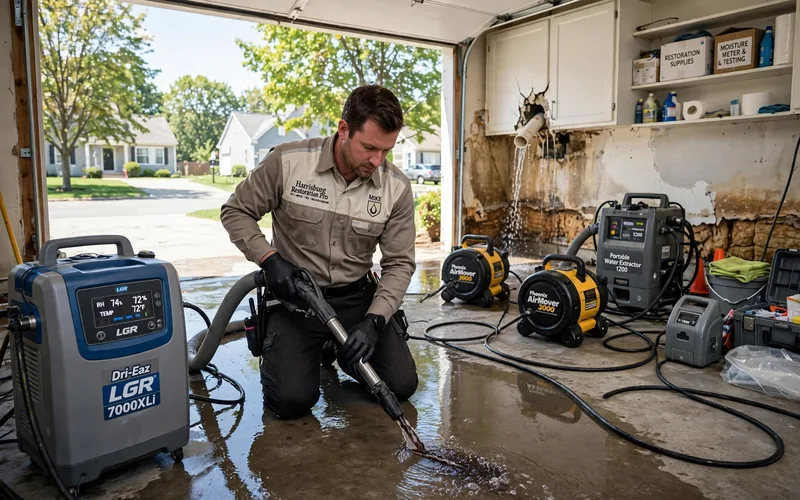
Pumps, extractors, and wet vacuums clear the floor, and we check how far the water slipped under walls and into nearby rooms.
Measure Beyond the Puddle
Moisture meters and a thermal camera show whether water reached studs, wall board, carpet, or finished flooring around the heater.
Remove What Cannot Be Saved
Saturated insulation, wall board, or carpet is cut out and hauled away so the rest can dry properly.
Dry the Space to a Standard
Air movers and dehumidifiers pull moisture from the structure, and daily readings tell us when materials are dry.
Different Locations, Different Problems
The Basement Corner
Water follows the slab to its low spots, and stored belongings and finished walls nearby can wick it up.
The Garage
A garage slab sends water toward the door and sometimes toward a shared wall with living space.
The Closet or Upper Floor
A heater above the ground floor can drip through the floor and stain the ceiling below. When that happens, we may open the ceiling to dry the space above it.
After Everything Is Dry
Once the area is dry and the heater is fixed or replaced, you can schedule repairs. When the water traveled well past the heater, our structural drying and dehumidification service covers the larger area, and if it reached the lower level, see basement water damage.